
Solar savings under
Solar ATAP.
Solar ATAP is the government scheme that replaced Net Energy Metering. It changes how your exported electricity is valued, which changes how a system should be sized. Here is what that means for your bill, in plain terms.
How does Solar ATAP work?
Your panels generate electricity during the day. Your home uses what it needs first, then exports leftover solar electricity to the grid.
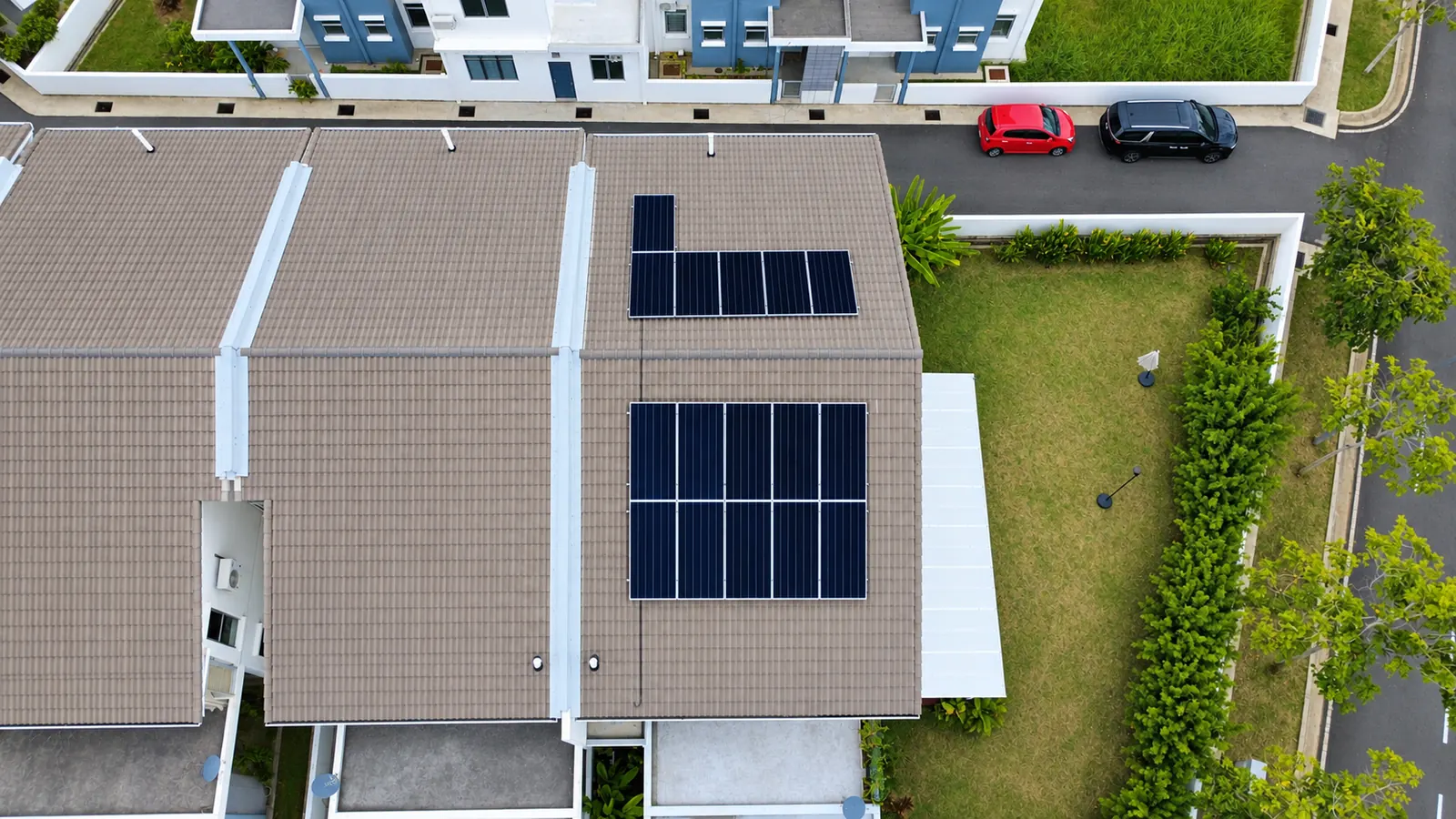
Your panels generate electricity
Your home uses it first
Extra solar is exported
At night, you use TNB as usual
Your solar is worth more when you use it.
When you use solar electricity directly in your home, you avoid buying that electricity from TNB and save at the full retail tariff. When you export it, you’re credited only at your applicable Energy charge.
How to get more from Solar ATAP.
Because solar is worth more when you use it directly, there are three practical ways to get more value from your system.
Use more solar during the day
Every unit used as it is made avoids 44 – 54 sen of charges. Every unit exported earns 27 – 37 sen.
Get the system size right
Bigger isn’t always better. Once your exports have offset 100% of the Energy charge on your bill, any further excess gives you no additional credit.
The hatched slice is 120 kWh a month with nothing left to offset, on a system that costs 20% more.
Move to a Time of Use tariff
Peak rates only apply from 2pm to 10pm weekdays, and your export credits offset peak charges first. This means that most of your usage can end up billed at off-peak rates.
Weekdays only. Weekends and public holidays are off-peak all day. Off-peak energy is 24.43 sen against 27.03 sen on the standard tariff — about 9% lower.
Illustrative calculations based on a household consuming 600 kWh per month, with 30% of solar generation used directly. The larger system assumes no increase in household consumption, with excess generation receiving no additional export credits. Actual savings will vary.
Get an instant quote and
a free home assessment.
SOLAR ATAP EXPLAINEDSolar ATAP vs NEM 3.0: which is better?
Solar ATAP is the better choice today because it is the only option new applicants can use (from 1 January 2026). Compared with NEM 3.0, Solar ATAP credits exported solar at the Energy Charge (EC) rates (RM0.27–RM0.37) at a fixed rate for 10 years, with no rollover of credits. It also supports larger systems (up to 15 kW) for 3-phase homes.
| FEATURE | SOLAR ATAP (2026 ONWARDS) | NEM 3.0 (CLOSED 30 JUNE 2025) |
|---|---|---|
| Status | Open since 1 January 2026 | Closed to new applications on 30 June 2025 (existing contracts continue) |
| Export credit | Credited at the Energy Charge rate (RM0.27–RM0.37 per kWh); cannot offset AFA | One-to-one offset against electricity used |
| Unused credit | No rollover: credits only offset that month’s charges | Rolls over up to 12 months, then forfeited |
| Contract | Up to 10 years, then self-consumption only | 10 years |
| System size (homes) | Single-phase 5 kW / three-phase 15 kW | Single-phase 5 kW / three-phase 12.5 kW (NEM Rakyat) |
| Quota | No stated limit; government-determined, first come first served | 700 MW (NEM Rakyat) |
| Rebate | SuRIA Home, up to RM3,000 (until 31 December 2026 or while allocation lasts) | – |
Estimates only, for illustration. Based on current policy and available information as at October 2026. Actual terms, rates and quotas may change.
Frequently asked questions
Am I eligible for Solar ATAP?+
How do I apply to participate in Solar ATAP?+
How long can I enjoy the benefits of Solar ATAP for?+
What happens after my Solar ATAP contract ends?+
What happens if I export more Solar Electricity than I can offset in a particular month?+
Solar ATAP is the Solar Accelerated Transition Action Programme, effective 1 January 2026 as the successor to Net Energy Metering. Export rates, capacity limits, and eligibility follow the guidelines published by the Energy Commission and SEDA Malaysia. We confirm the rates that apply to your account at the home visit.